
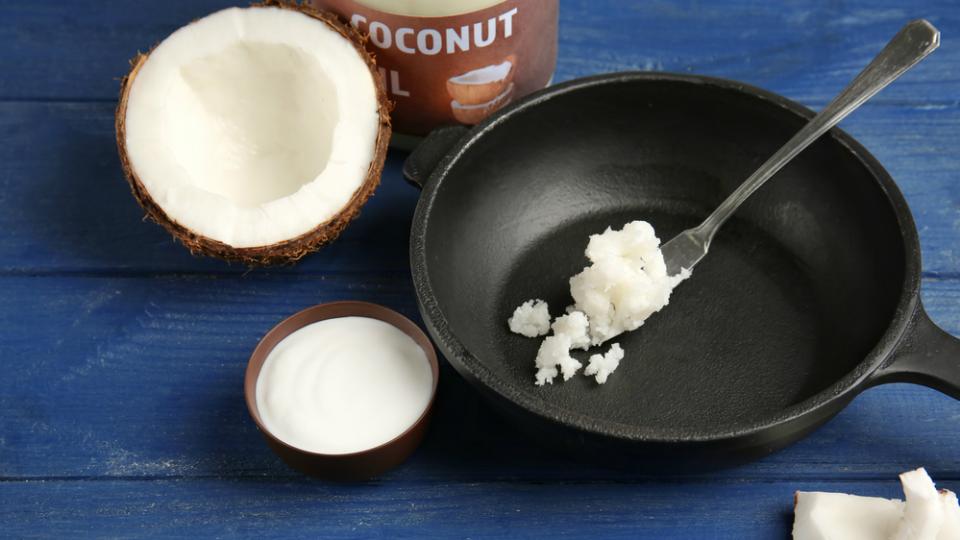
Coconut oil is an edible extract taken from the kernel of mature coconuts, in recent years this has gained an increasing amount of popularity in the health food world (4). The popularity increase is due to the promotion from blogs, internet videos, and articles claiming coconut oil has several health benefits if consumed (6). These benefits include lowering cholesterol, reduce the risk of cardiovascular disease, weight loss as well as other benefits however, coconut oil is high in saturated fat containing around 80-86% saturated fat twice the amount found in lard (6, 1). Saturated fat is known to increase LDL-Cholesterol (bad cholesterol) however, coconut oil is found to also increase HDL-Cholesterol (good cholesterol) a study by Khaw et al., (2018) assigned 94 middle-aged men and woman participants to one of three groups. They were allocated either extra virgin coconut oil, butter, or extra virgin oil and had to consume 50g of their allocated fat each day for 4-weeks. Results found significantly different changes in both LDL and HDL cholesterol concentrations. Coconut oil was found to increase LDL however this was not a significant increase in LDL concentrations compared to olive oil. Although, coconut oil increased HDL significantly compared to butter and olive oil. Butter raised cholesterol ratio (HDL: LDL) more than the other groups as well as a significant increase in LDL concentration compared to the other groups. Coconut oil increased HDL significantly compared to the other groups, but coconut oil and olive oil had no significant difference in cholesterol levels compared to each other. This shows even though coconut oil is high in saturated fat this does not seem to act like a regular saturated fatty acid.
A reason for the health benefits found in coconut oil is likely due to the fact it is made up of medium-chain fatty acids which differ from long-chain fatty acids as this helps protect against heart disease instead of being the cause (4). This was discovered in the 1920s and 1930s through gas-liquid chromatography which found the main saturated fat was lauric acid which made up 45-52% of coconut oil (4). Myristic acid made up 16-21% with others making up the rest from 0-10% in saturated fats (4). A study by Denke and Grundy (1992) compared the actions of lauric acid, palmitic acid, and oleic acid on plasma concentrations of total cholesterol and LDL cholesterol in humans. Results found palmitic acid increased cholesterol concentrations the most, with lauric acid raising LDL-cholesterol two-thirds higher than the other two saturated fats, therefore, concluding that lauric acid must contribute to the cholesterol-raising properties of coconut oil. This makes lauric acid the LDL-raising fatty acid in coconut oil which acts differently from other medium-chain fatty acids.
Coronary artery disease is becoming a higher risk factor in the state of Kerala, India and this is thought to be because the most commonly used cooking oil in that area is coconut oil (3). A study by Vijayakumar et al., (2016) evaluated the impact of coconut oil and sunflower oil on cardiovascular risk factors in patients with stable coronary heart disease over two years. Results found no significant increase in lipid-related risk factors in either group, however, it was suggested that a two-year period may not be long enough to see a significant rise. The group size was small, and participants were also being medicated which may also influence results. Therefore, could not be concluded that coconut oil was the cause of the prevalence of coronary artery disease. Similarly, for weight loss some studies have been finding positive results with the use of coconut oil however, the diets of the subjects in these studies have been altered by increasing protein, fibre, and reducing carbohydrates therefore it cannot be singled out as the factor behind the weight loss results (6). Humans do not consume pure coconut oil and are generally difficult to work with compared to lab animals, therefore, reaching solid conclusions proves to be difficult (1).
To Conclude
It is recommended for a 2000 calorie diet between 44 g and 78 g of fat per day should be consumed however, fat adds up quickly due to the 9 calories per gram, compared to 4kcal of carbohydrates and protein, 3 tablespoons of coconut oil a day is already very close to that limit (1). Studies have found a rise in overall cholesterol from coconut oil increasing both HDL and LDL Cholesterol, this is due to the medium-chain fatty acids which differ from long-chain fatty acids helping protect against heart disease (4). Studies have shown some positive benefits for the intake of coconut oil however most of these studies are from mice and rats, human studies do not give a definitive result. There are numerous studies however showing that coconut oil raises LDL Cholesterol significantly more than monounsaturated and polyunsaturated oils (1). For this reason, coconut oil consumption is not advised although according to the British Nutrition Foundation, coconut oil can be included in the diet however this should be in small amounts and only part of a healthy balanced diet (1). There is no evidence strong enough to support the health benefit claims therefore studies and nutritionists advise against the use of coconut oil. My personal choice of cooking oil is sunflower oil as this is a polyunsaturated oil however, olive oil, virgin olive oil, extra virgin and vegetable oil are all perfectly good cooking oils which are either poly or monounsaturated fatty oils.
- Everything You Need to Know About Vitamin C
- Vitamin D and the Winter Months
- Everything You Need to Know About Vitamin K
- The Mediterranean Diet
- Everything You Need To Know About Vitamin E
References
- Berger, A. (2019) Coconut Oil: Friend or Foe? – Authentically Emily. Emilyakradi.com. [Online] [Accessed on 21 November 2020] https://emilyakradi.com/coconut-oil-friend-or-foe/.
- Denke, M. and Grundy, S. (1992) ‘Comparison of effects of lauric acid and palmitic acid on plasma lipids and lipoproteins’. The American Journal of Clinical Nutrition, 56(5) pp.895-898.
- K.R. Thankappan, B. Shah, P. Mathur, (2010). ‘Risk factor profile for chronic non-communicable diseases: results of a community-based study in Kerala, India’. Indian J Med Res, 131, pp. 53-63.
- Kappally, S., Shirwaikar, A. and Shirwaikar, A. (2016) ‘Coconut Oil – A Review of Potential Applications’. Hygeia J.D. Med., 7(2) pp.34-41.
- Khaw, K., Sharp, S., Finikarides, L., Afzal, I., Lentjes, M., Luben, R. and Forouhi, N. (2018) ‘Randomised trial of coconut oil, olive oil or butter on blood lipids and other cardiovascular risk factors in healthy men and women’. BMJ Open, 8(3) p.e020167.
- Lima, R. and Block, J. (2019) ‘Coconut oil: what do we really know about it so far?’. Food Quality and Safety, 3(2) pp.61-72.
- Vijayakumar, M., Vasudevan, D., Sundaram, K., Krishnan, S., Vaidyanathan, K., Nandakumar, S., Chandrasekhar, R. and Mathew, N. (2016) ‘A randomized study of coconut oil versus sunflower oil on cardiovascular risk factors in patients with stable coronary heart disease’. Indian Heart Journal, 68(4) pp.498-506.
 Evidence Based Nutrition
Leave a comment