
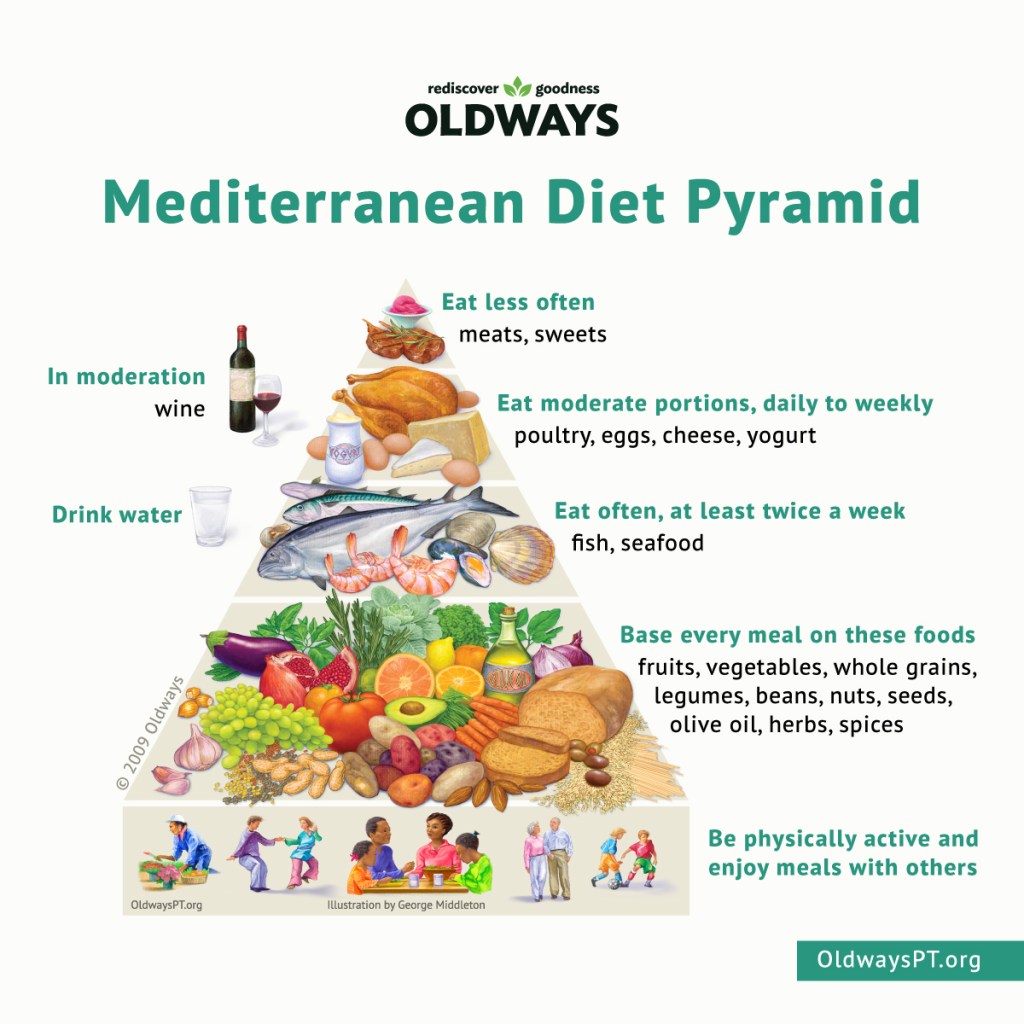
The Mediterranean diet was first defined by Ancel Keys during an epidemiological study observed in Greece and Italy during the 1960s (2). The observations were made due to the reduced incidence of cardiovascular disease and cancer found in the countries that overlook the Mediterranean Sea compared to other countries such as northern European countries and the United States (14). The Mediterranean diet consists of predominantly plant-based foods i.e., fruit, vegetables, pulses, nuts, seeds and olive oil but also fish and the occasional glass of red wine with a reduced intake of meat and low-frequency intake of red meats, sugary processed and saturated fatty foods (12). There is no single version of the Mediterranean diet as each different region vary slightly however, will still mostly include the foods mentioned above and all include the use of olive oil.
Due to the nature of this diet, there have been many studies supporting the health benefits of having a diet such as the Mediterranean. The first benefit as previously mentioned is the reduction of cardiovascular disease. Two cohort studies carried out in Spain found adherence to the Mediterranean diet was associated with a reduced risk of cardiovascular disease, and those with higher adherence had a 59% reduced risk of cardiovascular disease compared to those with lower adherence (6). Also, for those with cardiovascular disease, a study by Mitrou et al., (2007) found that those that had higher adherence to the Mediterranean diet had a 22% reduction in cardiovascular mortality in men and 29% reduction in women. The Mediterranean diet has also been associated with lower blood pressure, cholesterol, diabetes and inflammation (12). There is more and more evidence that the Mediterranean diet can not only be used to protect against type 2 diabetes but also be used as a treatment for those with type 2 diabetes and is recommended as an effective alternative to a low-fat high carb dietary pattern due to the beneficial effects it has on glycaemic control (3).
High adherence to the Mediterranean diet has shown evidence of counteracting the effect of stress on inflammation with a high fruit and vegetable intake in the Mediterranean diet giving plenty of anti-inflammatory foods is thought to be the reason for these effects on inflammation (8).
The Mediterranean diet has also been found to affect the prevention of neurodegenerative diseases such as Alzheimer’s and Parkinson’s disease (14). Scarmeas et al., (2006) found in a population of 2,258 whose cognitive function was evaluated every 1.5 years for 4 years that greater adherence to the Mediterranean diet reduced the risk of developing Alzheimer’s disease by 10%. Similarly, a meta-analysis by Sofi et al., (2008) found that adherence to the Mediterranean diet is significantly associated with a reduced risk of overall mortality (9%), cardiovascular mortality (9%), cancer incidence and mortality (9%), and incidence of Parkinson’s and Alzheimer’s disease (13%). Therefore, recommending a Mediterranean dietary pattern for primary and secondary prevention of major chronic diseases.
Positive effects have been found on type 2 diabetes when adhering to the Mediterranean diet. A systematic review and meta-analysis found that adherence to the Mediterranean diet was associated with a decreased risk of becoming diabetic by 19% (11). Not only has it been found to have benefits in the prevention of type 2 diabetes there is also evidence that the Mediterranean diet can be used as a treatment method for those already with type 2 diabetes, this is thought to be due to the fact the Mediterranean diet is predominantly plant-based (3).
The environmental footprint of the Mediterranean diet has also been researched and due to it being predominantly plant-based it has been found to have less of an impact on the environment when compared to the current Spanish dietary pattern (2013) and the western dietary pattern (10). Sáez-Almendros et al., (2013) found the Mediterranean diet to have lower demands on soil, water and energy resources. They estimated a reduction in the Spanish environmental footprint to be anything between 33% to 72% if a shift towards the Mediterranean diet was implemented. Therefore, it can be assumed that the Mediterranean diet is not only good for human health but also good for the health of the planet.
Athletes
Eating well is the first step in optimizing sport/exercise performance, the Mediterranean diet as discussed has many health benefits but how about applying this diet to athletes and sport and exercise performance? (5). What a person eats can influence weight, body composition, the energy available, recovery and performance (5). The Mediterranean diet is high in fruit and vegetables and other plant-based foods which contain antioxidant and anti-inflammatory nutrients. Physical exercise causes a varied amount of stress on the body which leads to inflammation and oxidative stress (1). Antioxidants and anti-inflammatories combat this, antioxidants such as polyphenols may protect against oxidative stress caused by exercise which could help with a better more effective recovery of the muscles (9, 1). However, this is based on what we know about the effects antioxidants and anti-inflammatories have on our bodies I could not find studies that specifically used this diet to test for recovery effectiveness or performance enhancement compared to other diets or any other method of research therefore, more research could be done on this subject. Factors such as the dose of nutrients, timing, individual responses, and the type and duration of exercise all play a role in the outcomes of possible studies in this area (1). Although the evidence does suggest the Mediterranean diet could play a role in certain aspects of health and performance in athletes (4).
Conclusion
Just a brief overview of the health benefits that following a Mediterranean-style diet could provide. Studies have shown that this diet can have protective effects against serious chronic diseases such as cardiovascular disease, cancer, type 2 diabetes, metabolic syndrome, Alzheimer’s, and Parkinson’s disease. It has also been associated with lower blood pressure, lower cholesterol levels and lower inflammation with a reduction in obesity and lower weight of those who follow the diet. Athletes and those that regularly exercise may find it beneficial to follow the Mediterranean diet also due to the high content of plant-based foods this diet contains a high number of antioxidants and anti-inflammatories which may help athletes with better muscle recovery and slow fatigue. As well as being beneficial for human health it has been found that Mediterranean diets are also better for the planet as the diet has a lower carbon footprint when compared to the western diet. Therefore, it is safe to say following a Mediterranean-style diet can only be beneficial for all involved.
- Everything You Need to Know About Vitamin C
- Vitamin D and the Winter Months
- Everything You Need to Know About Vitamin K
- The Mediterranean Diet
- Everything You Need To Know About Vitamin E
References
- D’Angelo, S. and Cusano, P. (2020) ‘Adherence to the Mediterranean diet in athletes’. Research Gate, 13(1) pp.58-63.
- Davis, C., Bryan, J., Hodgson, J. and Murphy, K. (2015) ‘Definition of the Mediterranean Diet; A Literature Review’. Nutrients, 7(11) pp.9139-9153.
- Georgoulis, M., Kontogianni, M. and Yiannakouris, N. (2014) ‘Mediterranean Diet and Diabetes: Prevention and Treatment’. Nutrients, 6(4) pp.1406-1423.
- Griffiths, A., Matu, J., Whyte, E., Akin-Nibosun, P., Clifford, T., Stevenson, E. and Shannon, O. (2021) ‘The Mediterranean dietary pattern for optimising health and performance in competitive athletes: a narrative review’. British Journal of Nutrition, pp.1-14.
- Laganà, P., Anna Coniglio, M., Corso, C., Lo Turco, V., Dattilo, G. and Delia, S. (2020) ‘Mediterranean diet, sport and health’. Progress in Nutrition, 22(3) pp.1-7.
- Martinez-Gonzalez, M. A., Garcia-Lopez, M., Bes-Rastrollo, M., Toledo, E., Martı ́nez-Lapiscina, E. H., (2011) Mediterranean diet and the incidence of cardiovascular disease: a Spanish cohort. Nutr. Metab. Cardiovasc. Dis. 21, 237–244.
- Martínez-González, M.Á.; Sánchez-Villegas, A. (2004) The emerging role of mediterranean diets in cardiovascular epidemiology: Monounsaturated fats, olive oil, red wine or the whole pattern? Eur. J. Epidemiol. 19, 9–13.
- Martini, D. (2019) ‘Health Benefits of Mediterranean Diet’. Nutrients, 11(8) p.1802.
- Philippou, E., Middleton, N., Pistos, C., Andreou, E. and Petrou, M. (2016) ‘The impact of nutrition education on nutrition knowledge and adherence to the Mediterranean Diet in adolescent competitive swimmers’. Journal of Science and Medicine in Sport, 20(4) pp.328-332.
- Sáez-Almendros, S., Obrador, B., Bach-Faig, A. and Serra-Majem, L. (2013) ‘Environmental footprints of Mediterranean versus Western dietary patterns: beyond the health benefits of the Mediterranean diet’. Environmental Health, 12(118).
- Schwingshackl, L., Missbach, B., König, J. and Hoffmann, G. (2014) ‘Adherence to a Mediterranean diet and risk of diabetes: a systematic review and meta-analysis’. Public Health Nutrition, 18(7) pp.1292-1299.
- Serra-Majem, L., Roman, B., Carta, L., Ángel, M. and González, M. (2008) ‘Effectiveness of the Mediterranean diet in the elderly’. Clinical Interventions in Aging, 3(1) pp.97-109.
- Sofi, F., Cesari, F., Abbate, R., Gensini, G. and Casini, A. (2008) ‘Adherence to Mediterranean diet and health status: meta-analysis’. BMJ, 337(sep11 2) pp.a1344-a1344.
- Sofi, F., Macchi, C., Abbate, R., Gensini, G. and Casini, A. (2013) ‘Mediterranean Diet and Health’. BioFactors, 39(4) pp.335-342.

 Evidence Based Nutrition
Leave a comment